
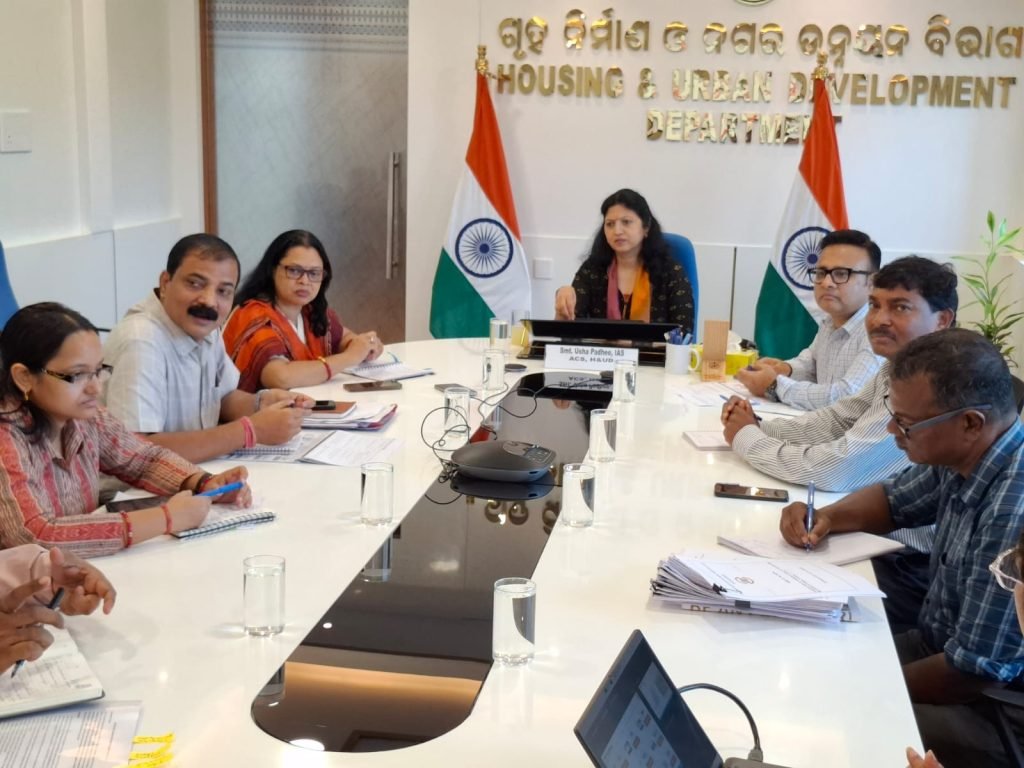

Bhubaneswar: Additional Chief Secretary, Housing & Urban Development Department, Usha Padhee chaired a review meeting on the functioning of CRUT at Kharavela Bhawan, Bhubaneswar.
She directed officials to take concerted and time-bound measures to further improve the quality, safety and reliability of Ama Bus services.
MD, CRUT, Md. Sadique Alam, Additional Secretary-cum-GM Sahadev Samadhia, Joint Secretary, H&UD Department, Smt. Mamatarani Naik, Financial Advisor, CRUT, OSD, CRUT, Manager (Operations) and other concerned senior officers were present at the meeting.
The ACS reviewed the overall operational performance of CRUT, including fleet and route operations, road safety, passenger services, crew management, digital systems, financial sustainability, infrastructure and the organization’s future expansion plans. She advised the officials to closely monitor service delivery and take prompt corrective action wherever gaps are identified, with the primary objective of ensuring a safe, reliable, efficient and commuter-friendly public transport system.
CRUT currently operates 770 buses across seven cities, including 390 electric buses, covering 138 routes and serving around 3.5 lakh passengers daily. The organization has also been strengthening technology-driven governance through Intelligent Transport Management Systems (ITMS), GPS-based VE tracking, Command and Control Centre monitoring, CCTV, passenger information systems and operational dashboards.
Road safety and crew performance received particular attention during the review. CRUT has recorded a 52 per cent reduction in accidents compared to the corresponding period of the previous year.
Enhanced driver training, mandatory alcohol testing, speed monitoring, regular safety training and KPI-based assessment of crew members have been put in place. The five-day SuVahak training programme has also been strengthened with dedicated modules on electric-bus operations. Steps are underway for the introduction of Advanced Driver Assistance Systems (ADAS) and Driver Fatigue Monitoring Systems (DFMS) in the existing fleet.
Padhee stressed that technology and infrastructure must ultimately result in better service for commuters. In this context, the meeting reviewed digital ticketing, live bus tracking, ETA information, passenger feedback mechanisms and other technology-enabled services. CRUT is also strengthening last-mile connectivity through Sarathi services and electric feeder-bus operations. The feeder service pilot is presently recording an average daily ridership of around 4,000 commuters.
CRUT is also promoting wider adoption of digital and integrated ticketing solutions, including the National Common Mobility Card (NCMC), to provide commuters with greater convenience and seamless access to public transport services.
Workforce strengthening and employee welfare were also reviewed. CRUT has expanded refresher training, introduced specialized electric-bus training, undertaken psychometric evaluation and health interventions, and linked crew performance with defined KPIs. The presentation indicates that the entire crew has been certified through Sakha training, while 118 crew members have received performance-linked recognition.
The meeting also examined CRUT’s financial sustainability and institutional strengthening. Despite affordable fares and public service obligations, cost recovery has improved and is currently around 65 per cent. Future measures include organizational restructuring, automated vendor and billing management, asset monetization, AI-enabled scheduling and phased expansion of services.
CRUT is also working towards expanding its public transport network to more cities, with a focus on increasing fleet strength, expanding route coverage and improving commuter access to reliable public transport services. The expansion strategy is aimed at meeting the growing mobility needs of citizens while strengthening the overall urban public transport ecosystem.
To further strengthen last-mile connectivity, CRUT is exploring opportunities for Public-Private Partnership (PPP) models and other collaborative approaches for the introduction and expansion of feeder and allied mobility services. The organization will also explore the possibilities of PPP-based interventions to improve service coverage, operational efficiency and commuter convenience.
Padhee directed CRUT to institutionalize continuous monitoring of routes, schedules, fleet utilization, safety indicators, passenger grievances and crew performance. She emphasized that accountability at every level, timely resolution of operational issues and regular assessment of commuter feedback are essential for sustaining public confidence in the Ama Bus service.
She further directed the concerned officers to ensure effective follow-up of the decisions taken during the review and implement necessary measures within defined timelines so that CRUT continues to evolve as a safe, efficient, technology-enabled and citizen-centric urban public transport system.

Comments are closed.